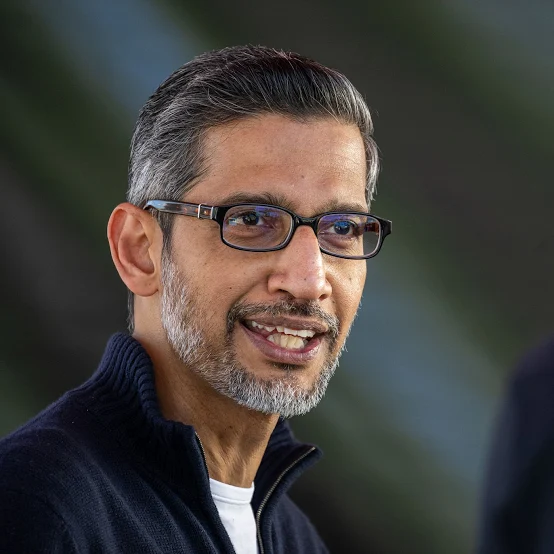
Biography
Sundar Pichai, born Pichai Sundararajan, is an Indian-American business executive who became chief executive officer of Google in 2015 and chief executive officer of its parent company, Alphabet, in 2019.
Pichai joined Google in 2004 and initially worked on product management and software development. He became widely associated with Google Chrome and later took on leadership responsibilities across major Google products.
As CEO, he has overseen Google's search business, Android, Chrome, YouTube, Google Cloud, and the company's expanding artificial intelligence initiatives.
Early Life and Education
Pichai was born on June 10, 1972, in Madurai, Tamil Nadu, India, and grew up in Chennai. His father worked as an electrical engineer, and his family placed importance on education.
He studied metallurgical engineering at the Indian Institute of Technology Kharagpur, graduating with a degree in the field. He subsequently moved to the United States for further study.
Pichai earned a master's degree in materials science and engineering from Stanford University. He later received an MBA from the Wharton School of the University of Pennsylvania.
Career Before Google
Before joining Google, Pichai worked in engineering and product management. His experience included work at Applied Materials and a role in management consulting at McKinsey & Company.
These positions gave him experience in technology, business strategy, and product development before he moved into a role at one of the world's major internet companies.
Google Chrome and Product Leadership
Pichai joined Google in 2004. He became involved in products including the Google Toolbar and later played a leading role in the development and launch of Google Chrome, which was released in 2008.
Chrome grew into a major web browser, and Pichai's responsibilities expanded to include other important products and platforms. He subsequently oversaw product areas including Chrome, ChromeOS, and Android.
His work focused on making Google's services available across devices and improving the integration of its software and online products.
Becoming Google's CEO
Google announced Pichai as its CEO in August 2015, as part of a corporate restructuring that established Alphabet as the parent company. He became responsible for Google's principal internet and consumer technology businesses.
In December 2019, Pichai also became CEO of Alphabet, succeeding Larry Page in that role. His responsibilities expanded to include oversight of Google's parent organization and its broader corporate structure.
During his leadership, Google continued to expand its advertising, subscription, cloud, hardware, and digital services businesses.
Artificial Intelligence at Google
Artificial intelligence has become a central part of Google's technology strategy. The company has invested in AI research, specialized computing infrastructure, models, and tools for developers and consumers.
Google's AI work includes the Gemini family of models, AI features in Search, cloud-based AI services, and tools integrated into products such as Workspace.
The development of generative AI has also raised questions about accuracy, privacy, copyright, computing costs, and the impact of AI on information discovery. These issues are important considerations for Google as it develops and deploys new technologies.
Google Cloud and the Broader Business
Google Cloud provides computing infrastructure, storage, databases, analytics, cybersecurity, and AI services to businesses and developers.
Under Pichai's leadership, cloud computing has remained an important part of Google's business strategy alongside its advertising and consumer services. The company has also continued developing hardware products and subscription offerings.
Leadership and Business Strategy
Pichai's leadership has involved managing large consumer products while guiding Google's investments in cloud computing and AI. His responsibilities span engineering, product development, business operations, and regulation.
Google's size and influence have brought ongoing scrutiny over online advertising, competition, privacy, search distribution, and the effects of AI-powered products.
Career Timeline
Graduates from IIT Kharagpur
Completes a degree in metallurgical engineering.
Joins Google
Begins working on product management and software.
Google Chrome launches
Chrome is introduced as Google's web browser.
Leads Android
Takes on additional leadership responsibilities for Android.
Becomes Google CEO
Leads Google following the formation of Alphabet.
Becomes Alphabet CEO
Assumes leadership of Google's parent company.
Expands AI initiatives
Oversees Google's growing focus on generative AI and AI infrastructure.
Influence on the Technology Industry
Pichai's career has been associated with the development of widely used internet products and the expansion of Google's services across browsers, mobile operating systems, cloud infrastructure, and AI.
His leadership illustrates the challenge of managing established global technology products while investing in emerging computing platforms and responding to changing user expectations.
Sources and Further Reading
The following sources provide additional information about Pichai's background and Google's leadership.